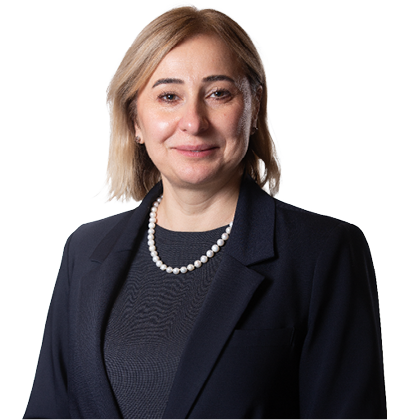
As the climate crisis evolves, we are witnessing a rise in the frequency of catastrophic consequences. Could you comment on how TSKB, which stands out with its exemplary practices in sustainability and ESG, has progressed in this area and what has been achieved so far?
I would like to start with a few recent findings on the impacts of the climate crisis. The World Meteorological Organization (WMO) recently confirmed that 2024 was the hottest year recorded based on six international datasets. The last decade, 2015-2024, was the warmest decade on record, and, likely, we have also left behind the first calendar year in which the global average temperature was 1.5°C above the 1850-1900 average. In 2024, there were extraordinary increases in land and sea surface temperatures and ocean heat. All of these findings mean that the Paris Agreement’s long-term temperature goal is still valid, but that our world is in serious danger. The need to rapidly increase global efforts and contributions to climate action becomes clear as we examine these and countless other scientific data points.
TSKB has a special role in Türkiye’s economic development. In the 1980s, TSKB pioneered a new approach in Türkiye by integrating environmental factors into its credit assessment processes, thereby establishing the foundations for sustainable banking.
Since its establishment, TSKB has differentiated itself as a forward-thinking and visionary bank. In the 2000s, driven by the demands of the international financial institutions it collaborates with and the influence of emerging mega trends in the market, it began to internalize sustainability, implement it in every aspect, and elevate it to new heights.
We have set an example and reached out to thousands of institutions and organizations involved in the economic cycle with the projects we have financed, as well as the numerous initiatives we have implemented in sustainable banking and the international initiatives we have signed. TSKB has become one of the first banks to come to mind and one of the most respected reference points in sustainability, both globally and locally.
To clearly illustrate our strong position in sustainable finance and the impact we are making, I would like to share some examples of our achievements against our sustainability targets through the end of 2024. During the reporting period, the share of loans linked to the SDGs in the Bank’s total loan portfolio was 92% while the share of loans contributing to the climate and environment-focused SDGs was 58%.
TSKB aims to increase its SDG linked financing volume to more than USD 10 billion by 2030, and as of 2024, it has reached a total financing volume of USD 5.2 billion, achieving 52% of its target. Our net contribution to this target in 2024 was USD 1.8 billion. Similar targets and achievements are discussed in detail in related capital sections of our report.
For TSKB, which provides development banking services, sustainability is not only a way of doing business and a fundamental philosophy that shapes its relationships with stakeholders but also the focus of its products and services and its key advisory strength.
We will continue in 2025 and beyond to focus increasingly on our targets in sustainable financing, to build new global relationships, and to finance investments that will generate a positive impact on the environment and society. In addition to our lending channel, we will effectively leverage our investment banking, capital markets, and advisory services and the capabilities we have built in these areas to support the green transformation of Türkiye and the private sector. We have significant leverage to achieve this goal through our strong financial and non-financial capital elements.
How do you evaluate your ESG performance within the scope of international ESG rating agencies and indices? Do these assessments influence your reporting approaches?
Sustainability indices focus on the environmental, social, and governance performance of companies. By eliminating ESG risks through their dynamic structures, they play a critical role in helping investors build sustainable portfolios and make the right investment decisions.
TSKB was included in 7 international indices by the end of 2024. With an ESG Risk Rating of 7.4 and an Management Score of 70.9, our bank ranked first in Türkiye, 15th out of 98 global development banks, 18th in the global banking sector, and 70th out of nearly 15,000 institutions rated by Sustainalytics as of 30 October 2024.
TSKB is listed in the Borsa Istanbul Sustainability Index and has improved its position in the index with a score of 85 points in the LSEG ESG rating and has been rated as one of the best banks in Türkiye. TSKB’s Corporate Governance Rating increased from 96.55% (9.66 out of 10) to 96.67% (9.67 out of 10) as of 18 October 2024 following the corporate governance rating study conducted by SAHA Rating. We believe that having our ESG performance recognized with high ratings on domestic and international platforms is valuable and important in signaling our consistent performance.
We will continue to use ESG ratings and indices to monitor our performance in a comparable and transparent manner. We are also committed to improving how we communicate sustainability and, as always, to fully implementing the new regulations that are going to be introduced.
As a first step, TSKB became a member of the Net-Zero Banking Alliance in 2022. In 2023, it has committed itself to the Science-Based Targets Initiative for emissions targets. How would you describe your Sustainable Finance Strategy, which you have updated to reflect current conditions and developments, and what would you like to share about your future targets?
The Net-Zero Banking Alliance is a groundbreaking initiative in sustainable finance. It brings together the world’s leading banks in a shared commitment to achieve net-zero emissions by 2050. The alliance is an important step in aligning the banking sector with global climate goals and was created under the umbrella of the United Nations Environment Program Finance Initiative (UNEP FI). Participating banks commit to strong climate action, including setting interim targets, developing transparent policies, and disclosing progress.
Having committed the Net-Zero Banking Alliance, our Bank received approval from the Science-Based Targets Initiative to adopt the targets that make up its net zero roadmap. Details on our targets are included in the relevant sections of our report. I would like to take a moment here to remind you of our commitment to end coal financing by the end of 2035, in line with our NZBA commitment and our SBTi targets. Continuing this commitment, our Bank has updated and communicated its Climate Change Mitigation and Adaptation Policy to include the decision that it will not participate in additional investments to expand capacity in coal-fired thermal power plants and coal mining for electricity generation.
We believe that by communicating effectively with all of our stakeholders, we can achieve our targets for the period ahead. Through active participation in the working groups of national and international initiatives and regulatory bodies, we have the opportunity to build capacity and evaluate potential collaborations by sharing our experiences. We participated in workshops to develop and implement the National Green Taxonomy, the Turkish Sustainability Reporting Standards, and the draft Green Asset Ratio Communiqué with public and regulatory bodies such as the Ministry of Environment and Urbanization’s Directorate of Climate Change, the Ministry of Industry and Technology, the Ministry of Trade, the Ministry of Treasury and Finance, the Banking Regulation and Supervision Agency (BRSA), and the Public Oversight Authority.
In August, we updated our Sustainable Finance Framework to reflect the latest principles published by the International Capital Markets Association (ICMA), market dynamics, and best practices. We were one of the first in the world to include the transition finance dimension in our framework document. We were also the first institution in Türkiye to receive a second-party opinion in this regard. Thus, in the coming period, we will be able to use transition financing to support the green investments of our companies operating in high-emitting sectors.
At TSKB, we work for the sustainable development of Türkiye through our financing and advisory solutions, drawing on our specialized human capital, know-how, focused approach, and deep-rooted international cooperation in the field of development and investment banking. In 2024, following organizational revisions, we established the Climate Change and Sustainability Management Department.
I am convinced that every step we take will strengthen the sustainability know-how and business skills that we have been building up for more than 20 years and will be a source of motivation for us in the future.
I would like to take this opportunity to extend my respect to all our internal and external stakeholders who have partnered with us on our long-term and forward-looking sustainability journey.
MERAL MURATHAN
Executive Vice President and Sustainability Leader